
TRACEs is grounded in IncuBrighter’s ethical foundation:
once we perceive someone’s context, we become responsible for responding to it with clarity, compassion, and appropriate support.
TRACEs makes that clarity possible.
caregivers of complex youth deserve programs that support them.
TRACEs
TRACEs (Trauma and Relational Adversity in Caregiving Environments) is IncuBrighter’s assessment framework designed to help professionals understand the full ecological context surrounding youth and families who interact with multiple systems. Instead of focusing on individual pathology, TRACEs examines the environment the caregiver of a complex child is living inside: their caregiving structure, relational stability, system involvement, safety factors, and emotional load.
TRACEs was built because traditional trauma assessments often miss the conditions that matter most—the chronic instability, system fragmentation, caregiver burnout, and cumulative adversity that shape how families of complex youth cope, behave, and survive.
It describes the conditions surrounding them, offering a clearer understanding of:
the pressures shaping caregiver behavior
instability, conflict, or systemic strain within the home
relational ruptures and bonds
environmental predictability and safety
the role of multi-system involvement (SUD, mental health, education, juvenile justice, child welfare, etc.)
the emotional and logistical demands placed on youth and caregivers
gaps in support that affect functioning and wellbeing
The goal is simple: help practitioners see the whole story, so interventions are aligned with reality.
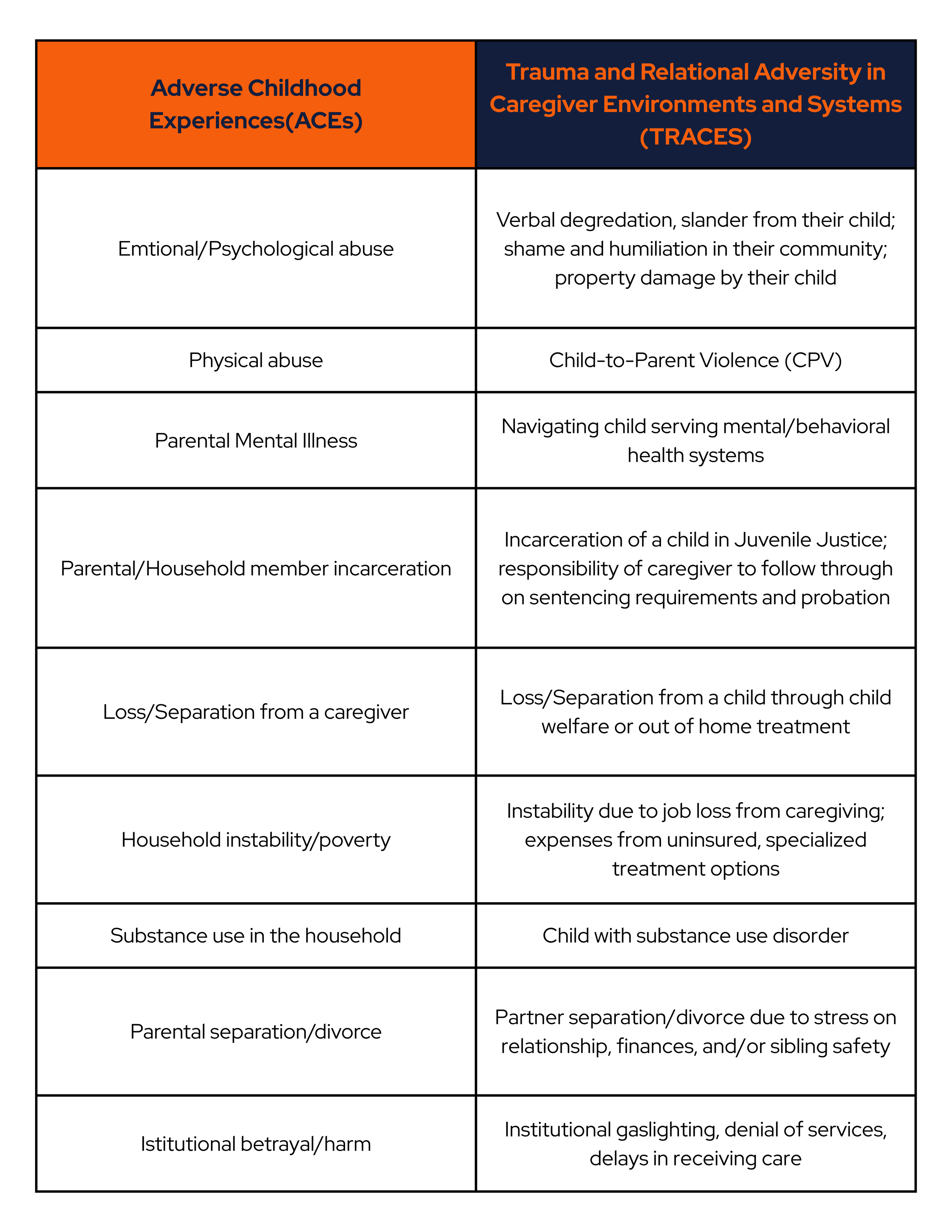
acknowledging caregiving trauma
Caregivers of multi-system-involved youth (navigating mental health, juvenile justice, education, and child welfare) are often expected to hold the system together. But what happens when that system fails them?
This work argues that their experience is not just “stress” or “burnout.”
It’s trauma.
Key Concepts:
TRACEs (Trauma and Relational Adversity in Caregiver Environments) parallels ACEs, naming the invisible trauma caregivers carry.
Child-to-Parent Violence (CPV) is a form of family trauma—often silenced or misunderstood.
Systemic strain, institutional betrayal, and stigma compound caregiver pain, leading to collapse.
Why This Matters:
When caregiver trauma goes unrecognized:
Support becomes punishment
Silence becomes survival
Systems collapse under the weight they asked caregivers to carry
What We Need:
Caregiver-Inclusive Assessments
Peer-led, trauma-informed interventions
Language shifts from “noncompliant” to “system fatigued”
Policy and funding reform rooted in lived experience
Caregivers navigating these systems often endure sustained relational and institutional adversity, including:
Child-to-parent violence (CPV)
Emotional degradation and public stigma
Instability due to caregiving-related job loss or financial strain
Institutional betrayal, delays, or denial of services
TRACEs reframes caregiving as a high-impact trauma exposure point.
It demands that we extend trauma-informed approaches beyond children to include those who care for them— acknowledging their grief, stress, and secondary trauma as valid and urgent.
This framework challenges systems to recognize, resource, and respond to caregiver trauma with the same care afforded to children.
FAQs
What is TRACEs and who developed it?
1
TRACEs (Trauma and Relational Adversity in Caregiving Environments) is an original assessment framework developed by Leah Buzek, Founder of IncuBrighter. It was created to address a gap in how professionals assess and respond to caregiver trauma in multi-system youth and family contexts.
How is TRACEs different from the ACEs (Adverse Childhood Experiences) framework?
2
ACEs focuses on adverse childhood experiences of the youth themselves. TRACEs shifts the lens to the caregiver: examining the relational, environmental, and systemic adversity experienced by the adults in a child’s life. Where ACEs asks what happened to the child, TRACEs asks what is happening to the people responsible for that child’s care.
Who uses the TRACEs framework?
3
TRACEs is designed for professionals working in child welfare, family services, peer support programs, and any human services setting where caregivers interact with multiple systems. Current pilot partners include Family Peers for Hope and St. John’s United.
Are the TRACEs tools available right now?
4
Yes. The 12-statement screener, 72-statement full assessment, and facilitator guide are available now in IncuBrighter’s Free Resources library at no cost.
Yes. Fill out the Pilot Partner Request Form to discuss what a pilot partnership looks like for your organization.
Yes. While IncuBrighter is based in Stark County, Ohio, TRACEs is a framework designed for broad application. It is currently being disseminated nationally through training and consulting engagements.
Can my organization become a TRACEs pilot partner?
5
Is TRACEs applicable outside of Ohio?
6
To use TRACEs in your non-clinical family support work, the 12-statement screening, the 72-statement assessment, and the facilitator guide are available in the TRACEs section of our free resources tab!
If you are interested in being a data contribution partner, Please fill out the partnership request form
support traces

Caregiver trauma is invisible—until we make it visible.
TRACEs is free to use because caregivers in crisis can't wait for systems to catch up. But building the evidence base, training programs, and advocacy work that drives systemic change requires resources.
Your donation powers:
✓ Research that proves caregiver trauma is real and measurable
✓ Training scholarships for programs that can't afford paid workshops
✓ Data infrastructure that shows patterns across thousands of families
✓ Policy briefs that push for better caregiver support
When you give to TRACEs, you're investing in the caregivers just out of frame—the ones absorbing the chaos, holding the pieces, and often breaking in silence.
IncuBrighter is a 501(c)(3) nonprofit organization. Your donation is tax-deductible to the fullest extent permitted by law.